


Key numbers
About 25% of US businesses used AI in the two weeks to 15 November 2026, up from about 17% a year earlier (Census Bureau).
Software, media and telecom firms: 49.6%. Transportation and warehousing: 9.9%.
Employers cited AI in 121,401 announced US job cuts from January to October 2026, about 20% of all announced cuts (Challenger, Gray & Christmas).
One in four US businesses used artificial intelligence in the first half of November, according to the Census Bureau's Business Trends and Outlook Survey. The share was about 25% in the two weeks to 15 November, up from about 17% a year earlier.
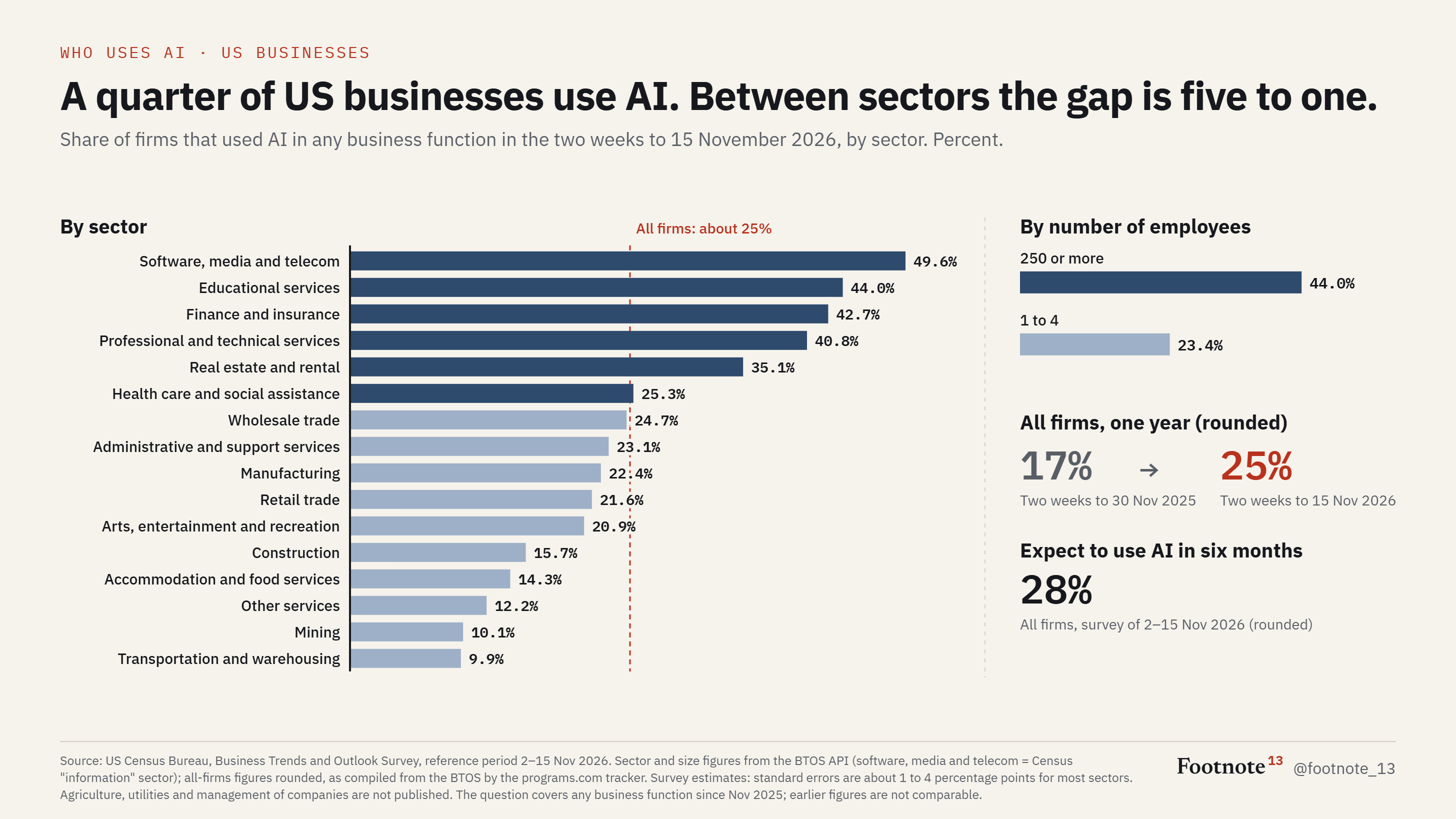
Software and media firms use AI five times as often as transport firms
Census groups software publishers, media, telecoms and data processing in its "information" sector. In that sector, 49.6% of firms used AI. The share was 44.0% in educational services, 42.7% in finance and insurance and 40.8% in professional and technical services, which include law, accounting and consulting.
Transportation and warehousing was lowest at 9.9%, followed by mining at 10.1% and other services at 12.2%. Manufacturing and retail trade were both below the national figure, at 22.4% and 21.6%.
Firm size also matters. Among firms with 250 or more employees, 44.0% used AI. Among firms with one to four employees, 23.4% did.
Most firms report no change in headcount from AI
The survey asks firms how AI affected their number of employees over the previous six months. Most of the firms that answered reported no change: 84% in finance and insurance and 77% in software, media and telecom.
In each of the ten sectors where Census publishes both figures, more firms said AI increased their headcount than said it reduced it. In software, media and telecom, 10.9% reported an increase and 6.1% a decrease. In manufacturing the figures were 6.2% and 1.9%.
Employers cited AI in 121,401 announced job cuts this year
Company announcements show a different side. Employers cited AI in 121,401 announced US job cuts from January to October 2026, about 20% of all announced cuts, according to outplacement firm Challenger, Gray & Christmas. In all of 2025 the figure was 54,836.
The monthly count peaked in May at 38,579, about 40% of that month's announced cuts. It fell to 1,265 in October, the lowest monthly figure of the year. Market and economic conditions, cited for 130,531 cuts, have overtaken AI as the most common reason given in 2026.
Several large employers have named AI directly:
Block said on 26 February that it would cut more than 4,000 of its roughly 10,000 staff. Chief executive Jack Dorsey said in a letter to shareholders that AI tools had changed how the company is built and run.
Oracle disclosed in its annual report, filed on 22 June, that its workforce fell to about 141,000 from 162,000 in the fiscal year to 31 May. It said AI deployment has "resulted, and may continue to result, in reductions to our workforce". Restructuring costs were $1.84 billion.
Salesforce chief executive Marc Benioff said in September 2025 that the company had reduced its customer support staff to about 5,000 from 9,000 as AI agents took on support cases.
Some employers are hiring again
Other companies have added staff or reversed AI-related cuts:
IBM's chief human resources officer said in February that the company would triple its US entry-level hiring in 2026, including for software developers.
Benioff said in April that Salesforce plans to hire 1,000 recent graduates. The company had cut fewer than 1,000 jobs in early February, and Business Insider reported this month that it had started a new round of job cuts.
In 2025, payments company Klarna resumed hiring customer service staff after its chief executive said AI-only service had lowered quality. Commonwealth Bank of Australia reversed 45 customer service job cuts linked to an AI voice bot and said its original assessment was an error.
Survey data show a similar pattern. In a March 2026 study by workforce planning firm Orgvue, 32% of organisations that had cut staff on expected AI savings said they had since rehired. Gartner expects half of the companies that reduced customer service staff because of AI to rehire for similar roles by 2027.
Employers also announced plans to hire 655,304 workers in the first ten months of 2026, including seasonal hiring, against 617,189 announced cuts, Challenger reported.
Limits of the data
The Census survey measures whether a firm used AI at all in a two-week period. It does not measure how much a firm spends on AI or how many of its workers use it. Census widened the question in November 2025 to cover any business function, so earlier figures are not comparable.
The figures are survey estimates. Standard errors are about one to four percentage points for most sectors, so small gaps between sectors are not statistically meaningful.
Challenger counts announced job cuts and the reasons employers give. An announcement is not the same as a job lost, and a company can cite AI for cuts made for other reasons.
Firms expect AI use to rise. In the same Census survey, about 28% said they will use AI in the next six months.
What to watch: Census publishes new figures every two weeks; the next release covers the two weeks to 29 November. Challenger's November report is due on 3 December. On Friday, Footnote 13 looks at when Big Tech's AI spending pays back.
Sources: US Census Bureau, Business Trends and Outlook Survey, reference period 2 to 15 November 2026 (sector and firm-size figures from the survey's public API; all-firms figures rounded, compiled from the survey by the programs.com tracker; Census does not publish figures for agriculture, utilities and management of companies). Challenger, Gray & Christmas, monthly job cuts reports to October 2026. Oracle annual report on Form 10-K, 22 June 2026. Block letter to shareholders, 26 February 2026. IBM, Salesforce, Klarna and Commonwealth Bank statements as reported by Bloomberg, Axios, Fortune and Entrepreneur. Orgvue, 12 March 2026. Gartner. Not investment advice.
How I make this: I choose the questions and the argument. AI tools (mainly Claude, made by Anthropic) pull figures from official data and filings, build the charts and draft text, which I edit. Every number is checked against its source.