


Anthropic shares opened at $111.50 on Nasdaq on Thursday, 34% above the $83 price of its initial public offering. The company sold $93.5bn of stock, including extra shares bought by the underwriters on 20 November, in what CNBC and the Associated Press call the largest IPO on record.
Disclosure: Footnote 13's analysis is produced with Claude, which Anthropic makes. The same rules apply to every AI lab here: filed numbers first, no buy or sell calls.
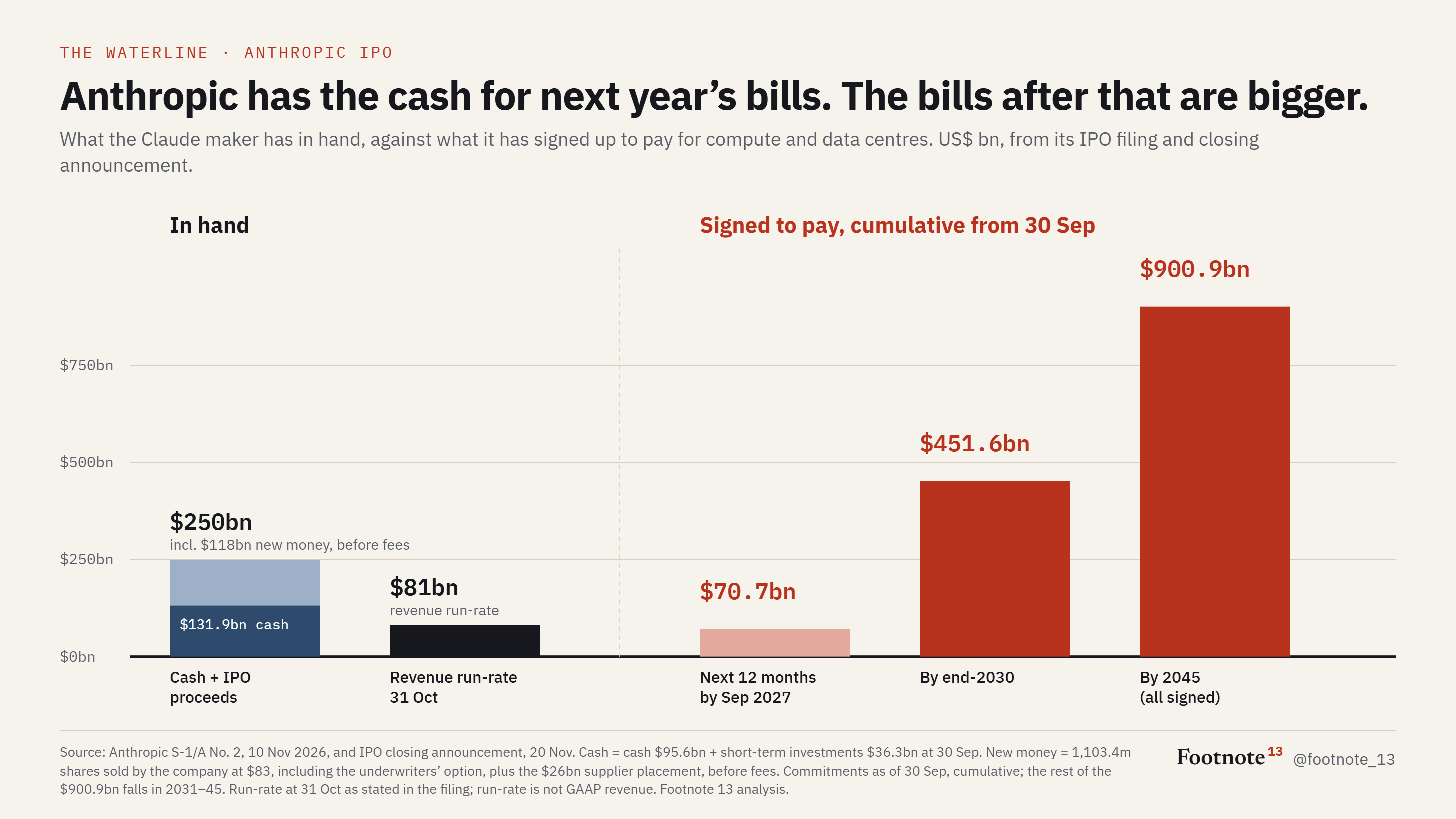
Anthropic has $900.9bn of signed commitments for chips, cloud capacity and data centres, according to the prospectus it filed with the Securities and Exchange Commission on 10 November. It reported $17bn of revenue in the third quarter and said its annualised run-rate revenue was about $81bn at the end of October, up $10bn from a month earlier.
Run-rate revenue is a company measure. The filing says it is not GAAP revenue and not a forecast.
Most of the $104bn net loss is non-cash
Anthropic reported a net loss of $104bn for the first nine months of 2026. Most of it is non-cash. The company records the convertible notes it issued to Amazon and Google at fair value, and a rise in that value is booked as a loss: $94.3bn in the period. Other expense, also largely non-cash, added $10.4bn. The operating loss was $1.26bn.
The notes will add to the share count. Amazon's remaining notes can convert into about 1.56 billion new shares after the IPO, according to the filing. Conversion would dilute other shareholders.
What falls due, and when
Some of the commitments are take-or-pay, meaning Anthropic pays whether or not it uses the capacity. About $70.7bn falls due in the 12 months to September 2027. Against that, the company held $131.9bn of cash and short-term investments at 30 September and raised about $118bn, before fees, from the IPO and a concurrent private placement.
By the end of 2030 the cumulative total is $451.6bn. That leaves about $381bn for the three and a quarter years from October 2027, or about $117bn a year, 1.4 times the current run-rate. Cash and the IPO proceeds cover the first year. Later payments depend on revenue growth or new funding.
Suppliers are also investors
Several of the companies Anthropic pays are buying its stock. Google and Nvidia are each investing about $10bn in a $26bn private placement at the IPO price. AMD, Broadcom, Micron, Microsoft and TSMC account for the rest.
Anthropic also competes with one of them. On 10 November it launched Claude Sheets, a spreadsheet product, along with whiteboard and dashboard tools. Microsoft, which sells Anthropic cloud capacity and is investing about $1bn in the placement, closed 2.2% lower that day. Nicholas Lin, an Anthropic product executive, described Sheets as "fairly basic", Bloomberg reported.
At the $83 offer price, Anthropic's fully diluted value was about $1.5 trillion, as reported by CNBC and the Associated Press, or about 18 times the October run-rate. At the opening price it was about $2 trillion, according to CNN, or about 25 times.
What to watch: the first quarterly report as a public company, and whether run-rate revenue approaches $117bn by 2028.
Tomorrow: what OpenAI and Anthropic owe for compute, by company and by year.
Updated 21 November: the proceeds figures and the chart now include the 147 million extra shares that the underwriters bought on 20 November.
Not investment advice.
How I make this: I choose the questions and the argument. AI tools (mainly Claude, made by Anthropic) pull figures from official data and filings, build the charts and draft text, which I edit. Every number is checked against its source.