


Last week I showed that four of the five big AI spenders now spend more than their cash flow brings in. This week is about the stuff that doesn't show up at all. Below the waterline, so to speak.
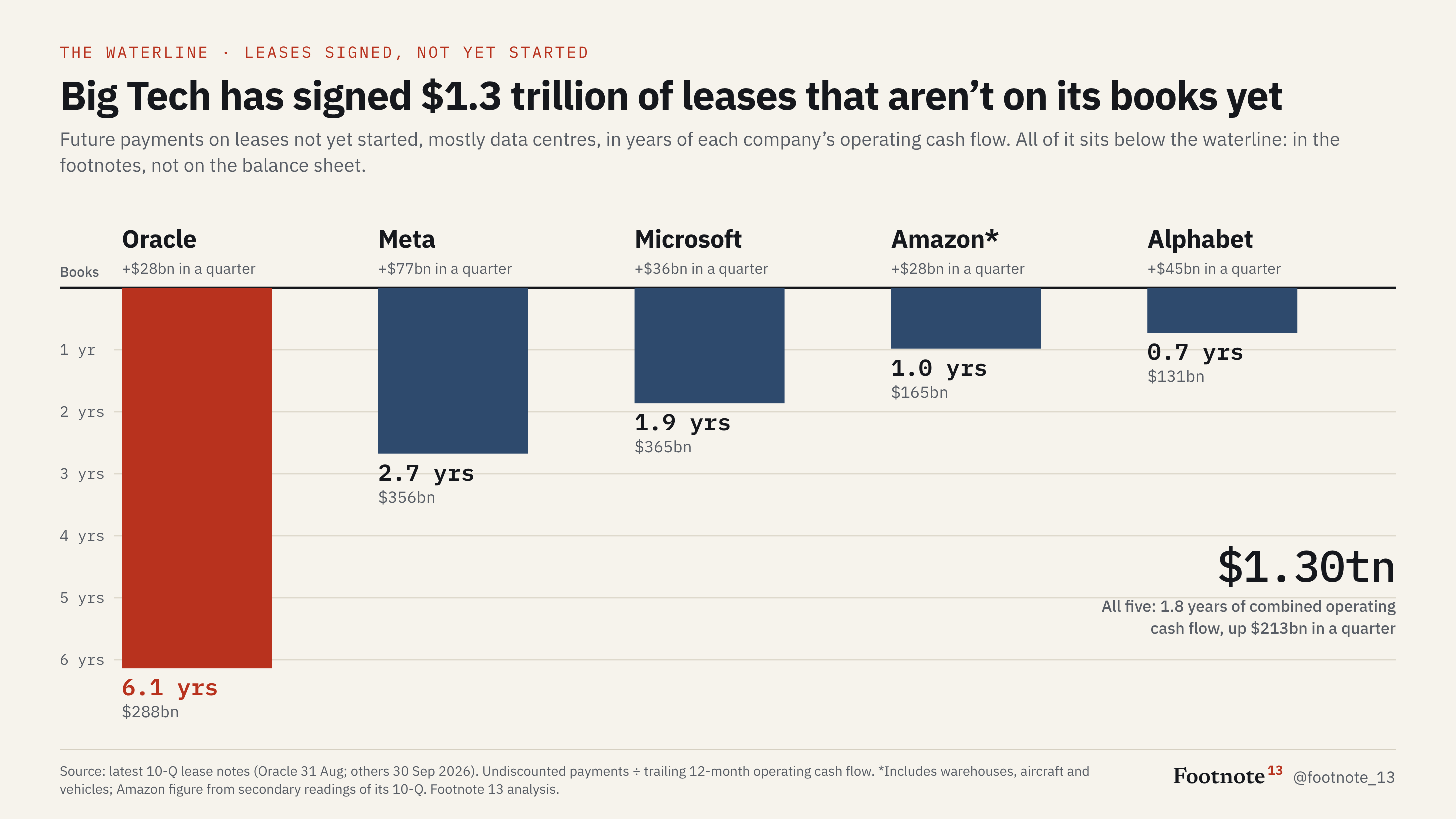
When a big tech company signs a long lease on a data centre that isn't built yet, nothing goes on the balance sheet. It sits in a footnote called "leases not yet commenced" until the building opens. I added up those footnotes for the five. It comes to about $1.3 trillion of future payments, and $213bn of that was added in a single quarter.
Raw dollars don't say much, so the chart divides each pipeline by one year of the company's operating cash flow:
Oracle: 6.1 years. $288bn vs $47bn of annual operating cash flow. Nearly all data centres, on 15–19 year terms. Oracle's own forecast has free cash flow turning positive by mid-2028 and above $30bn the year after.
Meta: 2.7 years. $356bn, $77bn of it added last quarter.
Microsoft: 1.9 years. $365bn, the biggest pipeline of the five.
Amazon: 1.0 year. $165bn, but that includes warehouses, planes and vehicles, not only data centres.
Alphabet: 0.7 years. $131bn, up 53% in a quarter.
What else isn't on the books
Joint ventures. Meta's Hyperion campus in Louisiana sits in a JV that Blue Owl owns 80% of, and the JV raised $27.3bn of bonds. A second one in Texas, with BlackRock, adds roughly $14bn. Meta leases both and guarantees the value of the buildings if it walks away: up to $41.5bn now, vs $28bn at the start of the year. No liability recorded, because Meta judges a payout not probable. S&P rated the Hyperion bonds A+, one notch below Meta. So on paper it's not Meta's debt, but the market prices it as Meta's credit.
Renting GPUs. Microsoft has signed over $60bn of multi-year contracts with smaller AI cloud companies, Meta up to about $62bn. That runs through operating costs over time, not capex.
Accounting. In July Microsoft stretched the assumed life of its data centres from 15 to 25 years. One side effect: more future leases count as operating leases rather than finance leases, and only finance leases go into its capex number. That took about $15bn off its calendar-2026 capex guide. Same buildings though.
Who is paying
Mostly bond investors. The largest cloud companies have sold more than $313bn of investment-grade bonds this year, nearly 3x last year. All five borrow now, even Microsoft, the only one still in surplus: $25bn last week, its first dollar bond since 2017. Amazon's long-term debt went from $65.6bn to $173.1bn in nine months. Meta has priced $37.5bn of new stock and plans about $60bn more. This week it borrowed another ~$25bn: $15bn in dollars, then €9bn in its first ever euro bonds, which pulled in €53bn of orders, a record for a European corporate deal. So there is demand, at a price. Its 2056 dollar bonds paid 2.20 points over Treasuries. In April it was 1.32. S&P moved Meta's outlook to negative last Friday and expects free operating cash flow of −$71bn next year.
Oracle is the clearest case of what this now costs. On 28 October it told investors one last $20bn would finish its funding. On Monday it raised the whole thing in a day: $10bn of stock at $116, 11% under the previous Friday’s close, and $10bn of bonds at 7% to 8.65%. The shares fell 8.8% that day. By Thursday they’d closed at $115.16, below the sale price. In February, Oracle’s 2046 bonds paid 1.70 points over Treasuries. Monday’s paid 3.35. Same company, nine months apart.
Why I think it matters
You can cut a capex plan. A signed lease that hasn't started is much harder to get out of. When these buildings open, mostly 2027–29, the payments come on top of spending that already runs ahead of cash flow. The rating agencies already count them: S&P puts Oracle's pipeline into its debt forecast, and Moody's has said the accounting liability may not reflect plausible future scenarios. Timing is less certain too. Texas, with about 27% of US data-centre capacity, just elected a governor who promised a moratorium on approvals.
The bull case is that these buildings have tenants. Oracle's backlog alone is $664bn. When that cash actually shows up is the real question, and I'll come back to it after Nvidia reports.
How I measured it: undiscounted future payments on leases signed but not yet commenced, from each company's latest 10-Q (Oracle 31 Aug 2026, the others 30 Sep 2026), divided by trailing 12-month operating cash flow to the same date. The quarterly change compares with 31 May for Oracle and 30 Jun for the rest. Amazon's number comes from secondary readings of its 10-Q and includes non-data-centre leases. Undiscounted payments overstate present value, so read them as scale, not debt. As a cross-check, Goldman Sachs counts about $1.3tn of not-yet-commenced leases at the same five; Moody's counted $662bn of not-yet-started data-centre leases at end-2025. Sources: company filings; Oracle term sheets (2 Feb and 2 Nov 2026); S&P Global Ratings; Moody's; Goldman Sachs; Bloomberg; Wells Fargo. Views are my own. Not investment advice.
How I make this: I choose the questions and the argument. AI tools (mainly Claude, made by Anthropic) pull figures from official data and filings, build the charts and draft text, which I edit. Every number is checked against its source.