


Welcome to Footnote 13. Every Friday: one chart on what the AI build-out is doing to the economy, from Big Tech’s cash and debt to power prices and jobs. Each one is built from company filings and official data, with the method under the chart. First up: who is paying for the data centres.
For two years the AI build-out paid for itself. Microsoft, Alphabet, Amazon, Meta and Oracle generated more cash from their businesses than they spent on data centres, chips and servers. That has stopped.
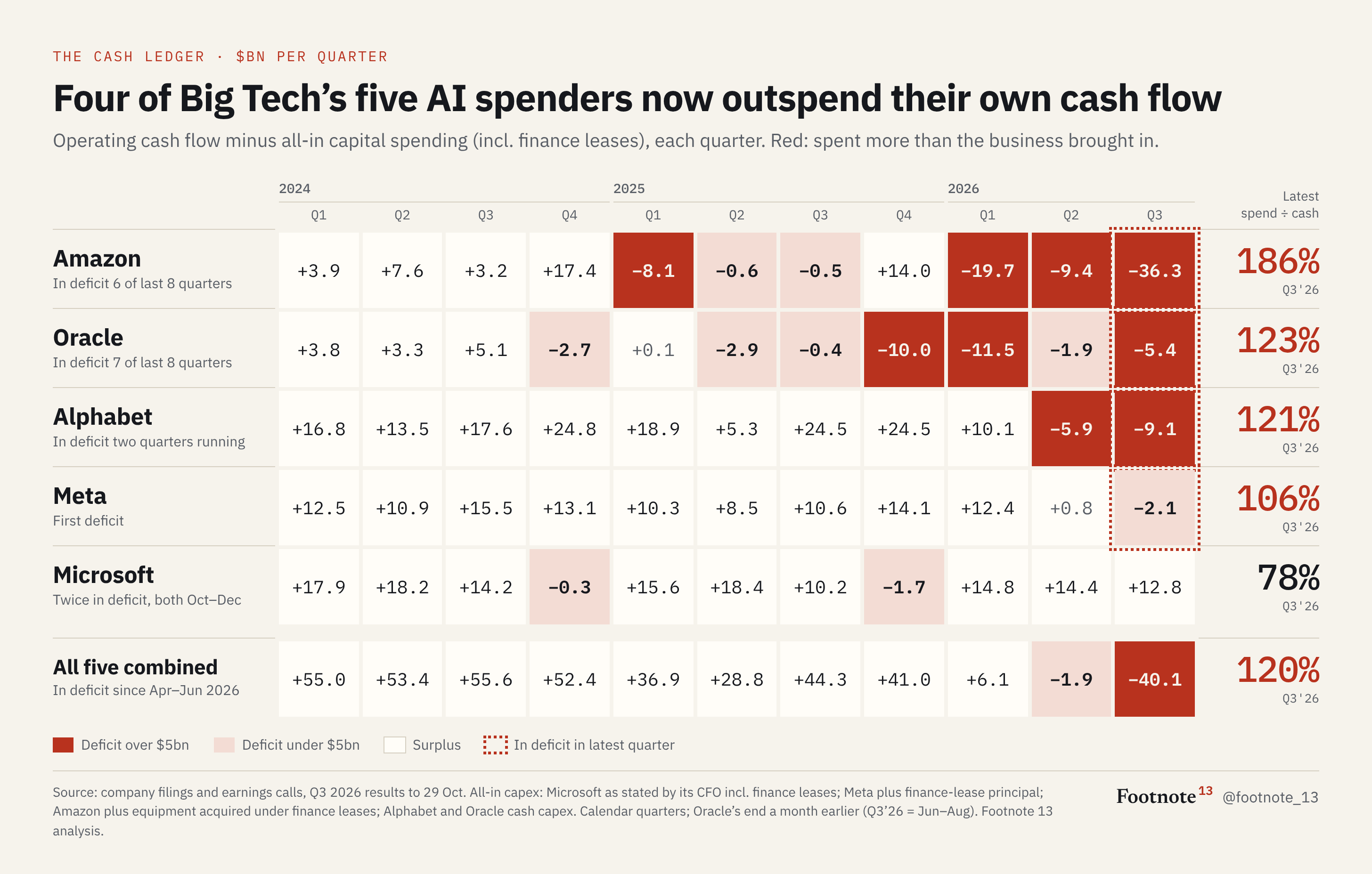
The ledger above shows each company’s cash gap every quarter: operating cash flow minus all-in capital spending, including data centres taken on finance leases. A red cell is a quarter in which the company spent more than its operations brought in.
Four of the five were in the red in their latest quarter. Amazon is the extreme: in July–September it spent $78.7bn against $42.4bn of operating cash, a $36.3bn gap and the largest in the ledger. That is $1.86 for every dollar its business brought in, and its third deficit in a row. Oracle has been in deficit in seven of the last eight quarters; in its latest it spent $1.23 for every dollar. Alphabet tipped into deficit in April–June and stayed there: in July–September it spent $51.4bn against $42.3bn of operating cash. Meta posted its first deficit in the same quarter. Both arrived about a year earlier than the trend projections Epoch AI published in June. Microsoft is the exception. It spent 78% of its cash last quarter and has slipped under only twice, both times in its seasonally weak October–December quarter.
Taken together, the five spent $188bn in April–June against $186bn of operating cash flow, their first combined deficit. Economists had been forecasting that crossover for some point in 2026. It has not just arrived; it has widened twentyfold. In July–September the five spent $239bn against $199bn of operating cash, a $40bn gap, or $1.20 for every dollar.
Why it matters: when spending outruns cash flow, the difference has to come from somewhere — cash piles, bond markets, new shares or partners. That is already happening. Amazon borrowed $48.1bn of long-term debt last quarter, Alphabet sold $12.4bn of shares, and Meta has just priced $37.5bn of new stock. Investors are keeping the same score. After results this week, Microsoft, the one still in surplus, barely moved. Alphabet fell 12.6%, its worst day on record, and Amazon fell about 7%.
What to watch: Alphabet says its 2027 capex will “increase significantly”, and Amazon says it will spend “meaningfully more”. Microsoft says it will stay free-cash-flow positive this fiscal year, and Oracle says it turns positive by mid-2028. Next quarter’s ledger will show whether those promises hold.
And this is the conservative view. It leaves out more than $1 trillion of data-centre leases signed but not yet started, off-balance-sheet joint ventures and GPU rental contracts. That’s next Friday’s Footnote. Subscribe to get it in your inbox.
How we measured it: operating cash flow minus capital expenditure including finance leases, as each company reports it. Microsoft: capex including finance leases (CFO remarks on each earnings call). Meta: purchases of property and equipment plus principal payments on finance leases. Amazon: purchases of property and equipment plus property and equipment acquired under finance leases. Alphabet and Oracle: cash capex. Calendar quarters; Oracle’s fiscal quarters end one month earlier. Sources: company filings and earnings calls, Q3 2026 results to 29 October. Not investment advice.