


American workers are taking home the smallest slice of what their companies produce since records began. Of every $100 of output US businesses produced in July–September, $53 went on wages, salaries and benefits. That’s the lowest share the BLS has recorded since its series started in 1947. In the early 1960s it was $66. At the end of 2019 it was about $56.
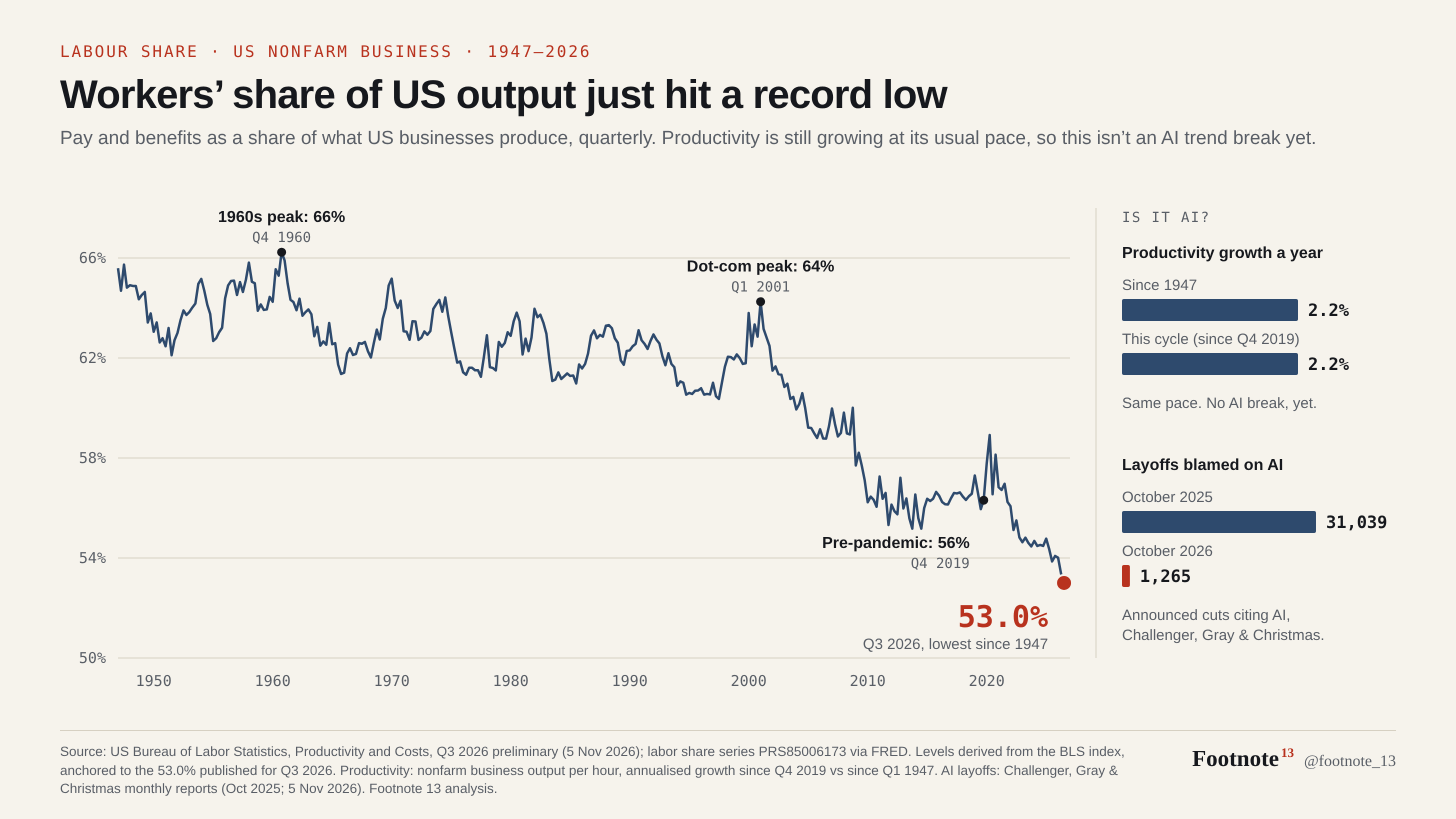
Everyone’s first guess is AI. Fair enough: the companies spending hundreds of billions on data centres are selling exactly that, more output with fewer people. If it were happening at scale, I’d expect two things in the data. Productivity running faster than normal, and companies blaming AI when they cut jobs.
I don’t see either. Not yet.
Productivity did jump last quarter, 3.6% at an annual rate. But one quarter tells you very little. Since late 2019, output per hour has grown 2.2% a year. The average since 1947? Also 2.2%. No trend break there.
Layoffs point the same way. Challenger, Gray & Christmas tracks job cuts where the employer names AI as the reason. October this year: 1,265. October last year: 31,039. AI is still about a fifth of all cuts announced in 2026, but most of those came in the spring, and “market and economic conditions” has since taken over as the top reason. The wider job market is fine, too: payrolls up 165,000 in October, unemployment at 4.1%, hourly pay up 3.1% on a year ago.
So pay is growing, just more slowly than the value of what businesses produce. That’s no surprise: the flip side is profit margins, which jumped during Covid and are now at their highest in about 60 years. And this didn’t start with chatbots. Labour’s share has been sliding since 2000, through several cycles, and economists still argue about why: globalisation, automation, market power, more of output going to software and other intangible capital. AI may well end up on that list. The data hasn’t put it there yet.
Two caveats. This is a first estimate, and first estimates move. In September the BLS called Q2 a record at 52.8%; after the annual revisions it’s about 53.3%. And one strong quarter of productivity is just that, one quarter.
What would change my mind: productivity well above 2.2% for several quarters in a row while the share keeps falling, plus employers once again naming AI as their main reason for cutting jobs, as they did most months this spring. Next checks: Challenger’s November count (3 Dec) and the BLS revision of these figures (8 Dec).
How we measured it: labour share is compensation as a percentage of nonfarm business output (BLS series PRS85006173). The BLS publishes it as an index; the percentages in the chart are derived by anchoring that index to the 53.0% the BLS published for Q3 2026. Productivity is nonfarm business output per hour. Layoffs are announced job cuts where the employer cited AI (Challenger, Gray & Christmas). Not investment advice.
How I make this: I choose the questions and the argument. AI tools (mainly Claude, made by Anthropic) pull figures from official data and filings, build the charts and draft text, which I edit. Every number is checked against its source.