


Update, 23 November: Nvidia’s board reinstated Jensen Huang as chief executive. The forecast ranges below are as of 16 November.
Nvidia reports on Tuesday under an interim CEO, five days after it announced Jensen Huang’s resignation. The shares closed Monday at $156.14, more than a third below their $243.37 intraday high. At least a dozen brokers have cut their price targets since the news, Bernstein from $400 to $200 and even the still-bullish Morgan Stanley from $300 to $267.
For all that, the analysts still broadly agree on this year. The 55 forecasts for Nvidia’s revenue in the year to January sit between $390bn and $427bn, a spread of 9%.
One year further out, that agreement falls apart. For the year to January 2028, the lowest of 57 forecasts is $506bn and the highest $778bn. That’s $272bn between them, or 39% of the average.
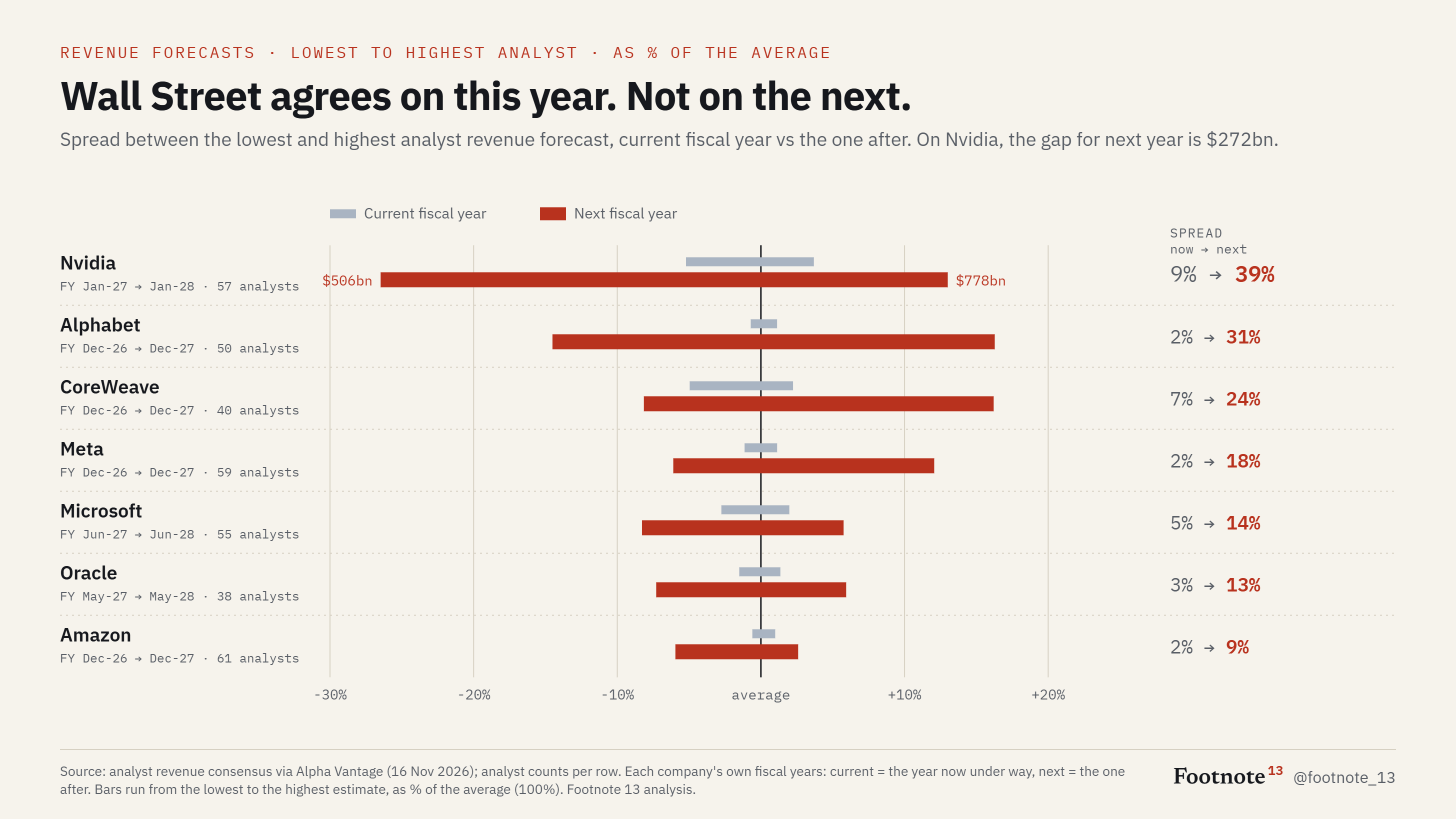
Nvidia isn’t alone. Across seven of the biggest names in AI, forecasts for the current year sit within 2% to 9% of each other. For the year after, the spread jumps: 31% for Alphabet, 24% for CoreWeave, 18% for Meta, 14% for Microsoft, 13% for Oracle. Only Amazon stays under 10%.
Some widening is normal. Forecasts for any company get looser the further out they go. What stands out is the size. A 39% gap isn’t a disagreement about margins. It’s a disagreement about whether the business roughly doubles again or stalls.
The reason is simple. This year’s revenue is largely locked in by contracts, backlogs and company guidance. Next year’s depends on how fast customers turn AI spending into AI revenue, and nobody has that number yet.
The spending side is far less uncertain. It’s already been signed: Big Tech has $1.3 trillion of leases that aren’t on its books yet, as I showed two weeks ago. The bills are fixed. The revenue that has to pay them isn’t.
What I’ll watch on Tuesday: whether Nvidia’s guidance narrows that $272bn gap, or whether the analysts at the bottom of the range move down to meet the new leadership.
Consensus figures: analyst revenue estimates via Alpha Vantage, 16 November 2026. Each company’s own fiscal years. Not investment advice.
How to cite: Footnote 13, “Wall Street can't agree on Nvidia's next year: forecasts $272bn apart”, 17 November 2026, footnote13.com. Big Tech’s AI spending, with sources, is tracked in the free Footnote 13 ledger: ledger.footnote13.com.
How I make this: I choose the questions and the argument. AI tools (mainly Claude, made by Anthropic) pull figures from official data and filings, build the charts and draft text, which I edit. Every number is checked against its source.