


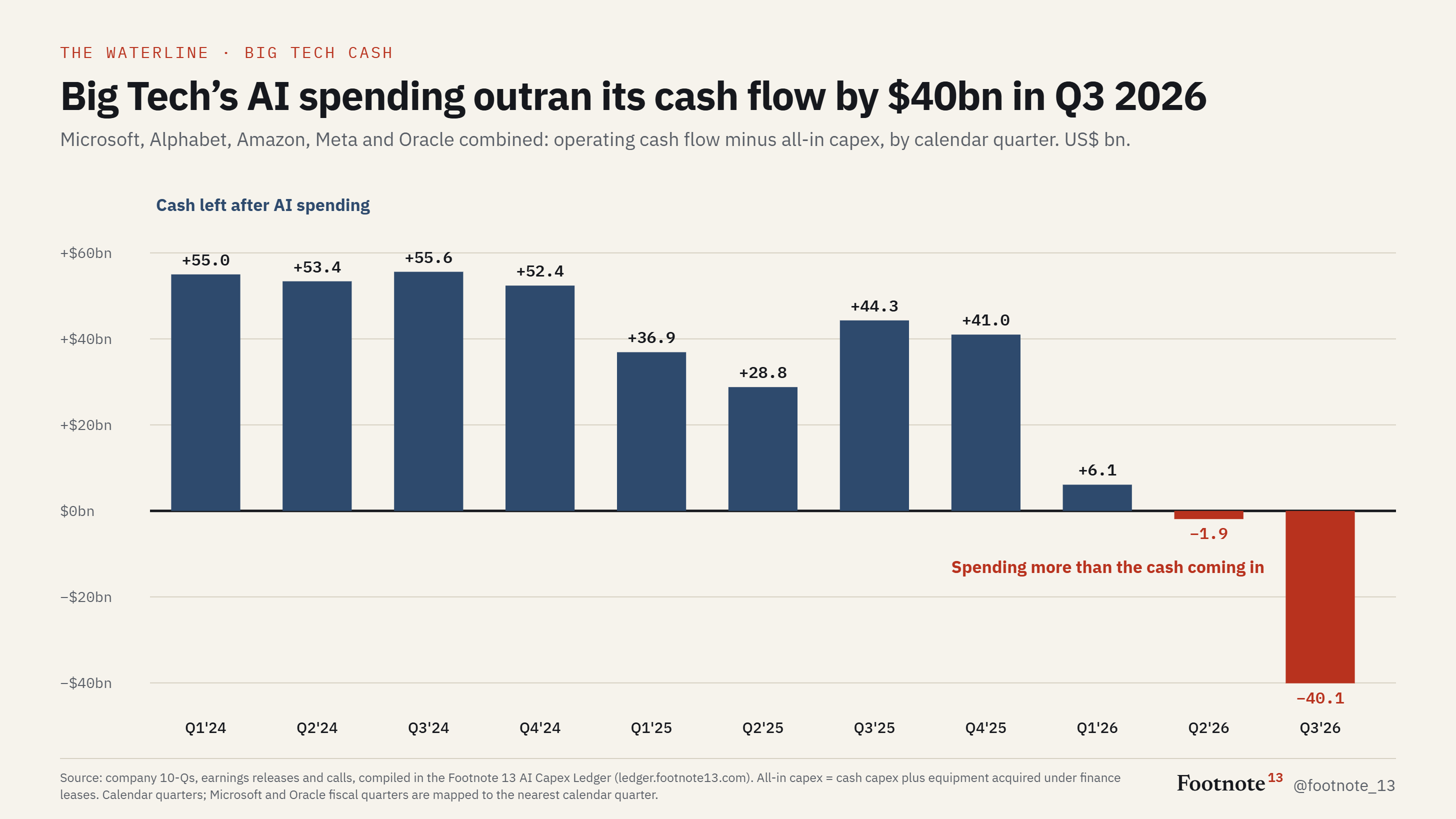
Microsoft, Alphabet, Amazon, Meta and Oracle spent $238.7 billion on data centres, chips and leased equipment between July and September. That was $40.1 billion more than the $198.6 billion their operations generated in cash, according to their quarterly filings. In the first quarter of 2024 the same five companies had $55.0 billion left after that spending.
Oracle is the only one of the five that has given a date for positive free cash flow. A Footnote 13 scenario puts the combined break-even in 2029, if cash flow grows 20% a year and capex rises 25% in 2027 and then stays level. That case is optimistic. Slightly slower cash-flow growth, or one more year of rising capex, moves the date to 2030 or 2031. These are scenarios, not forecasts.
This post has six parts: the cash gap, who owes whom, what lenders charge, where the money goes, the break-even model and the lease model.
1. The cash gap
Key numbers
Q3 2026: operating cash flow $198.6bn, all-in capex $238.7bn, gap −$40.1bn.
Q1 2024: gap +$55.0bn. The gap turned negative in Q2 2026 (−$1.9bn).
12 months to September: cash flow +29.6% to $723.8bn; all-in capex +81.6% to $718.7bn.
Company, Q3 2026 → All-in capex as % of operating cash flow:
Amazon: 186%
Oracle: 123%
Alphabet: 121%
Meta: 106%
Microsoft: 78%
All-in capex is cash capex plus equipment acquired under finance leases. Four of the five spent more than their operations brought in. Alphabet reported negative free cash flow of $5.9 billion in the second quarter and $9.1 billion in the third. The third-quarter figure includes an inventory build for its TPU chips and a $5.2 billion European Commission fine. Chief Financial Officer Anat Ashkenazi said on the 28 October call that Alphabet expects capex to "increase significantly in 2027". She left the 2026 range unchanged at $195 billion to $205 billion.
2. Who owes whom
The spending is backed by signed contracts. Microsoft, Oracle, Amazon and Alphabet reported about $2.48 trillion of contracted cloud revenue that they have not yet delivered. A large part of it depends on two customers.
Key numbers
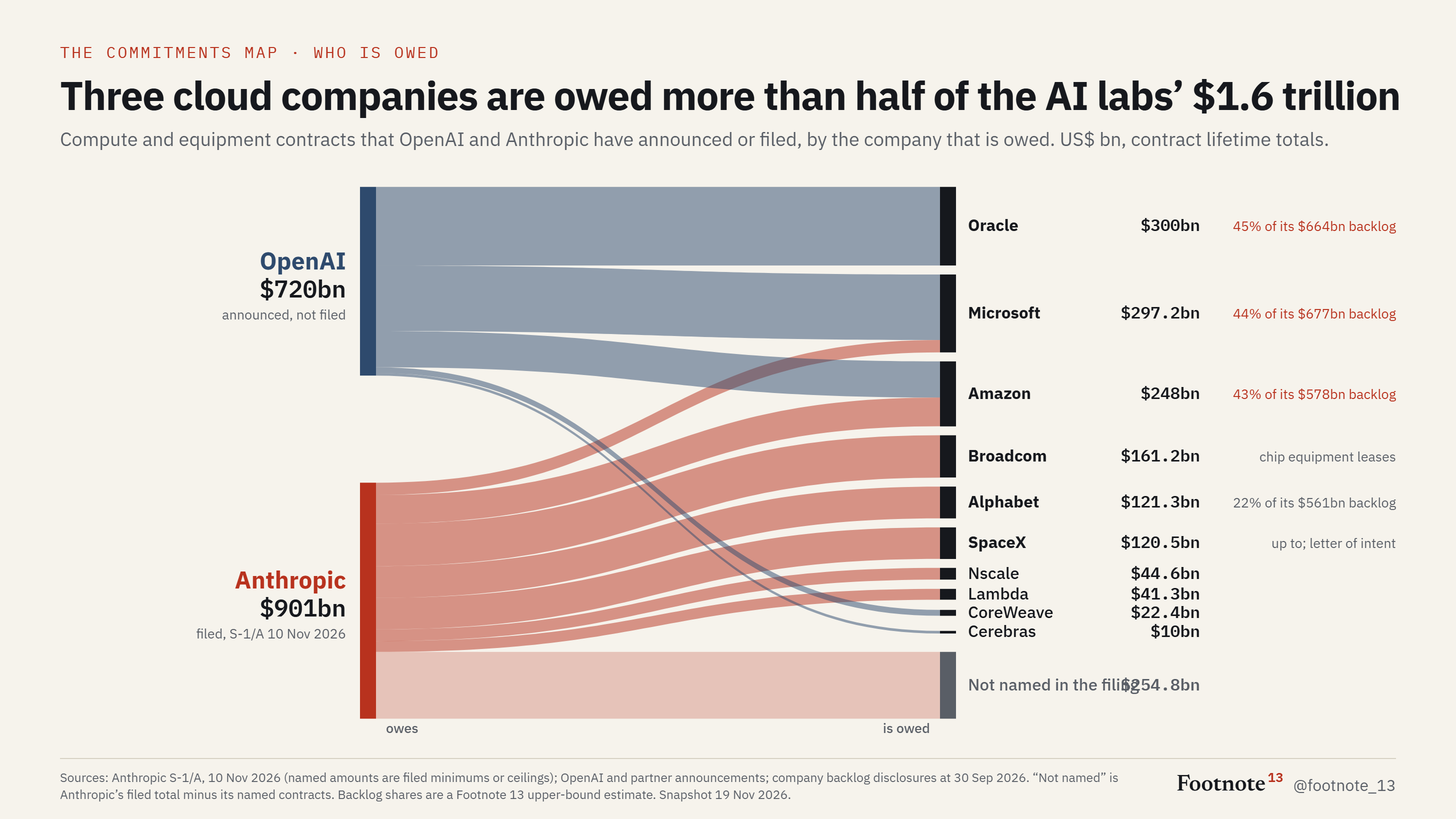
OpenAI and Anthropic have announced or filed about $1.62 trillion of compute and equipment contracts: $720bn at OpenAI, $901bn at Anthropic.
Oracle, Microsoft and Amazon are owed $845bn of it, or 52%.
Matched against the four cloud backlogs, the two labs account for about $966bn, or 39%.
Microsoft: Backlog, 30 Sep 2026 $677bn; Tied to OpenAI $250bn; Tied to Anthropic $47.2bn; Share of backlog 44%
Oracle: Backlog, 30 Sep 2026 $664bn; Tied to OpenAI $300bn; Tied to Anthropic –; Share of backlog 45%
Amazon (AWS): Backlog, 30 Sep 2026 $578bn; Tied to OpenAI $138bn; Tied to Anthropic $110bn; Share of backlog 43%
Alphabet (Google Cloud): Backlog, 30 Sep 2026 $561bn; Tied to OpenAI –; Tied to Anthropic $121.3bn; Share of backlog 22%
Total: Backlog, 30 Sep 2026 $2,480bn; Tied to OpenAI $688bn; Tied to Anthropic $278.5bn; Share of backlog 39%
Anthropic's figures come from its IPO filing, as recorded in the Commitments Map. OpenAI's come from company announcements and are not filed. The backlog shares are an upper bound: contract values are lifetime totals, some revenue has already been recognised, and some contracts may not be in reported backlog yet. Oracle's backlog is its latest reported figure.
Anthropic's filing shows $70.7 billion of compute bills due within 12 months. Nvidia said on its 17 November earnings call that the leading AI labs account for about 15% of its data-centre revenue this fiscal year.
I believe there is a risk that about half of this backlog is cancelled. New, more efficient algorithms keep arriving, and I expect the price of tokens to keep falling. Open models compete with the paid ones. If the labs earn less for each token than they planned, they cannot pay for all the capacity they have ordered. That is my opinion, not an estimate. The filings will test it: the question is whether the backlog due within 12 months grows in dollars each quarter.
So far assets have grown faster than revenue at Amazon's cloud unit. AWS segment assets rose by $125.5 billion to $419.6 billion in the six months to September, the company's filings show. AWS quarterly revenue rose by $8.4 billion to $46.0 billion over the same period. At Google Cloud, third-quarter revenue doubled from a year earlier to $30.7 billion and operating income was $11.1 billion.
3. What lenders charge
The five companies sold bonds 17 times in 2026 with pricing terms filed at the SEC. Footnote 13 read every term sheet: 115 separate bonds, worth about $207 billion in US dollars, plus €38.5 billion, C$28.5 billion and £5.5 billion. The measure used here is the spread over government bonds, or G-spread: the extra yield a company pays above the government bond of the same currency on the day it borrows.
Key numbers
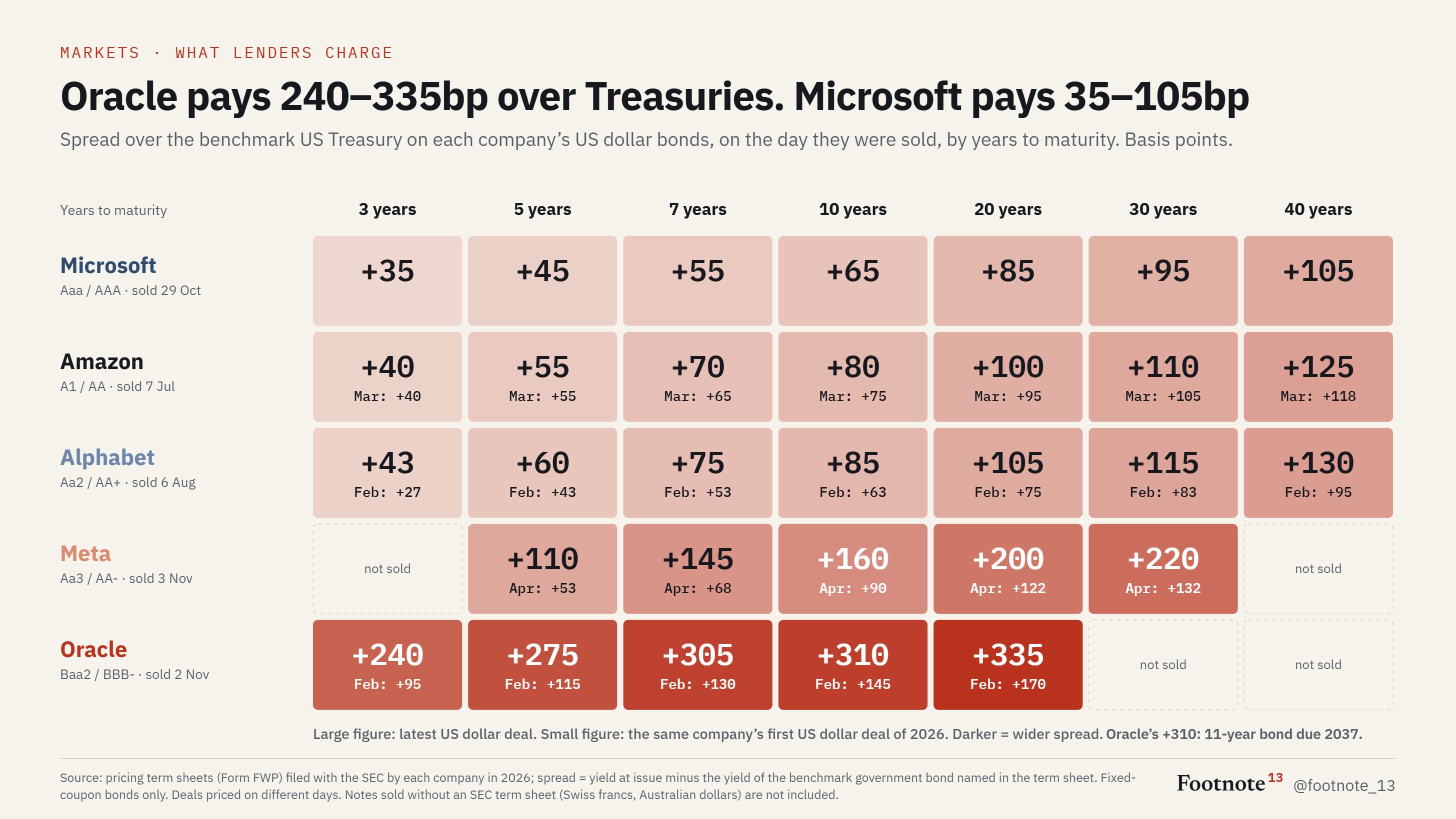
10-year dollar money: Microsoft 65 basis points over Treasuries (29 October), Amazon 80 (7 July), Alphabet 85 (6 August), Meta 160 (3 November), Oracle 310 (2 November, on an 11-year bond due 2037; it sold no 10-year bond that day).
Oracle's 10-year spread was 145 basis points on 2 February. Meta's was 90 on 30 April.
The $200bn of fixed-coupon dollar bonds pay 5.62% on average, about $11.2bn of interest a year.
Almost all of it pays a fixed coupon: 105 of the 115 bonds. About 40% of the fixed-coupon dollar bonds run for 20 years or longer. Alphabet sold a £1 billion bond that matures in 2126, at 6.125%, or 120 basis points over the gilt. The other ten bonds pay a floating rate and mature in two or three years. In dollars they pay 35 basis points over SOFR at Microsoft and 111 at Oracle.
A fixed coupon locks the cost for the life of the bond. Higher rates make new borrowing and refinancing more expensive. They do not change the cost of bonds already sold. The table shows how much more each company paid for 10-year dollars on its latest deal than on its first deal of the year, and where the increase came from.
Oracle: 10-year yield, first deal 5.73% (Feb); 10-year yield, latest deal 8.02% (Nov, 11-year bond due 2037); Change +2.29 pts; From Treasuries +0.64; From spread +1.65
Meta: 10-year yield, first deal 5.29% (Apr); 10-year yield, latest deal 6.55% (Nov); Change +1.27 pts; From Treasuries +0.57; From spread +0.70
Alphabet: 10-year yield, first deal 4.83% (Feb); 10-year yield, latest deal 5.52% (Aug); Change +0.69 pts; From Treasuries +0.47; From spread +0.22
Amazon: 10-year yield, first deal 4.90% (Mar); 10-year yield, latest deal 5.34% (Jul); Change +0.44 pts; From Treasuries +0.39; From spread +0.05
At Oracle and Meta, more than half of the increase came from the spread. That is the part lenders charge for the company's own risk. At Amazon and Alphabet most of it came from Treasuries. Microsoft sold one deal, on 29 October, its first dollar bond since 2017.
Key numbers
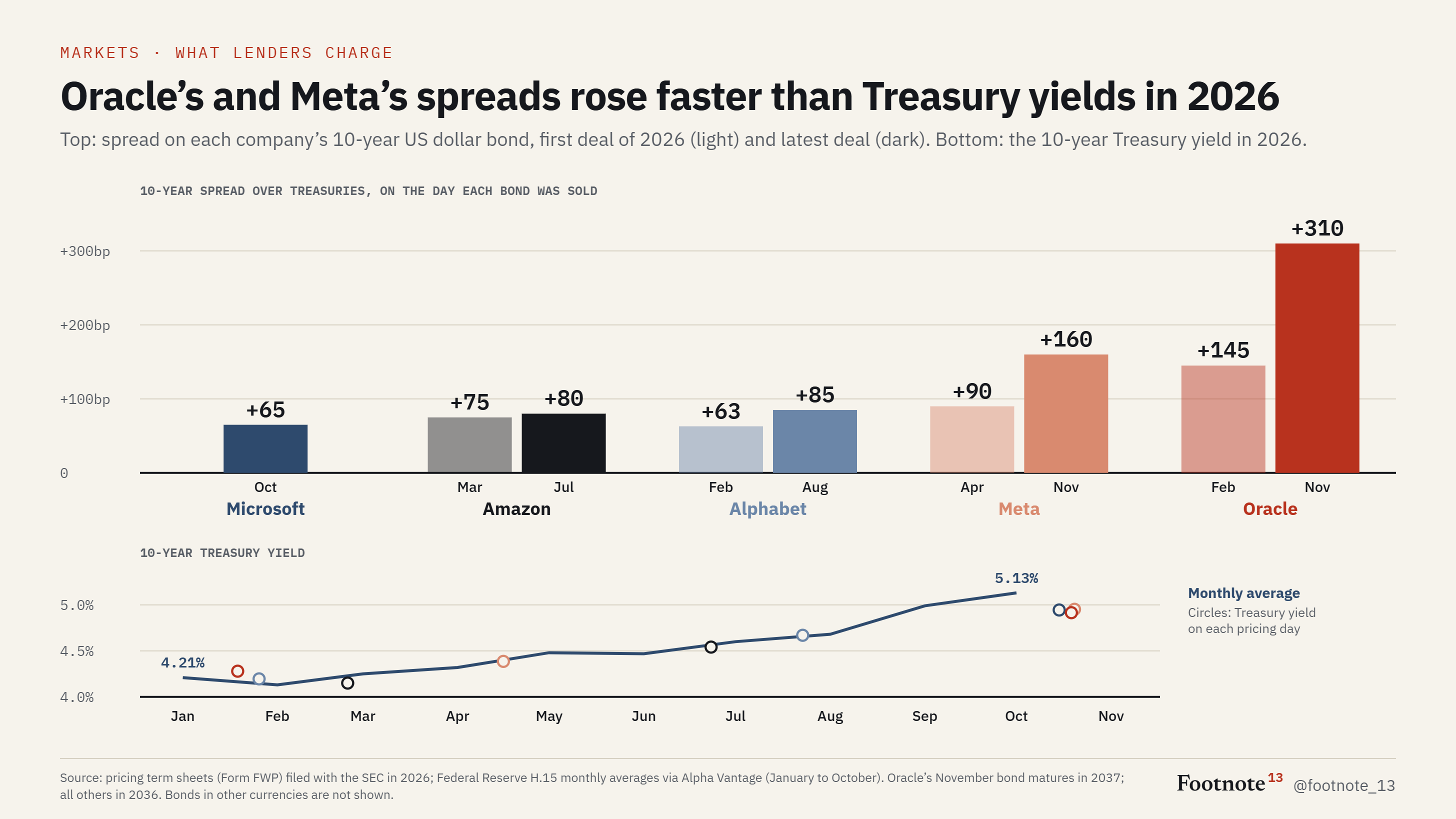
The 10-year Treasury yield averaged 4.21% in January and 5.13% in October, the highest monthly average since May 2002.
Over the same months Oracle's spread rose from 145 basis points on a 10-year bond to 310 on an 11-year bond due 2037 and Meta's from 90 to 160.
Amazon's moved from 75 to 80 and Alphabet's from 63 to 85.
The same pattern shows in other currencies. Alphabet paid 68 basis points over Bunds for eight-year euros in May and 128 for nine-year euros in November. Meta paid 172 over Bunds for nine-year euros on 4 November. The deals were sold on different days, so part of each gap reflects the market on that day.
Smaller companies pay more. CoreWeave, which rents out Nvidia chips, reported interest expense of $846 million in the third quarter and operating income of $207 million. The cost of insuring their debt kept rising. CoreWeave's five-year credit default swaps rose as much as 2.09 percentage points on 25 November, the most on record, to 15.34% a year, according to ICE Data Services figures reported by Bloomberg. Swaps on Oracle, Alphabet and Nvidia also set records that day. Oracle's had reached a record 356 basis points on 24 November, according to S&P Global Market Intelligence figures reported by Reuters.
Oracle has given dates for the turn. At its investor day on 28 October, management said free cash flow will turn positive in the second half of fiscal 2028, which runs from December 2027 to May 2028, and will exceed $30 billion in fiscal 2029. It capped new stock and bond sales through fiscal 2030 at $20 billion, half each, sold the full amount on 2 November, and on 20 November said its OpenAI contract was fully funded. These are company targets.
4. Where the money goes
Part of the five companies' spending is Nvidia's revenue. Nvidia reported revenue of $115.8 billion for the quarter to 25 October, up 103% from a year earlier. Data-centre revenue was $107.6 billion. The company returned $28.1 billion to shareholders in the quarter and guided to revenue of $130 billion, plus or minus 3%, for the current quarter. Nvidia's quarter ends one month later than the calendar quarter used for the five companies, and Nvidia also sells to other customers.
The railway precedent. The closest precedent is the American railway boom: a technology that worked, built faster than demand could pay for, and financed with debt. The Panic of 1873 began when railway investment ran ahead of traffic, according to Federal Reserve History. Jay Cooke & Co., the bank behind the Northern Pacific, failed that September. The second bust was larger. In 1893 alone, 74 railway companies with more than 32,000 miles of track went into receivership, the trade paper Bradstreet's reported. The trains kept running throughout. Gross railway earnings rose from $1.3 billion in 1899 to $2.3 billion in 1906, the economist Stuart Daggett wrote in 1908. By then much of the network had new owners: more than 40,000 miles of track were sold in foreclosure between 1894 and 1898, by Daggett's count. The railways succeeded. Many of the investors who financed them lost their money.
Three open questions. The views in this paragraph are mine. First, pricing: lower-priced and open-weight models have followed each leading model within months, so the companies that pay for the data centres may not keep the profit. Second, timing: I expect AI to change office work, starting with software development and call centres, but I do not expect large-scale replacement of jobs within five years. Third, proof: AI is sold as a way to replace labour, and that has not yet been shown at scale.
5. The model: when does cash flow cover capex?
Scenarios, not forecasts.
Key numbers
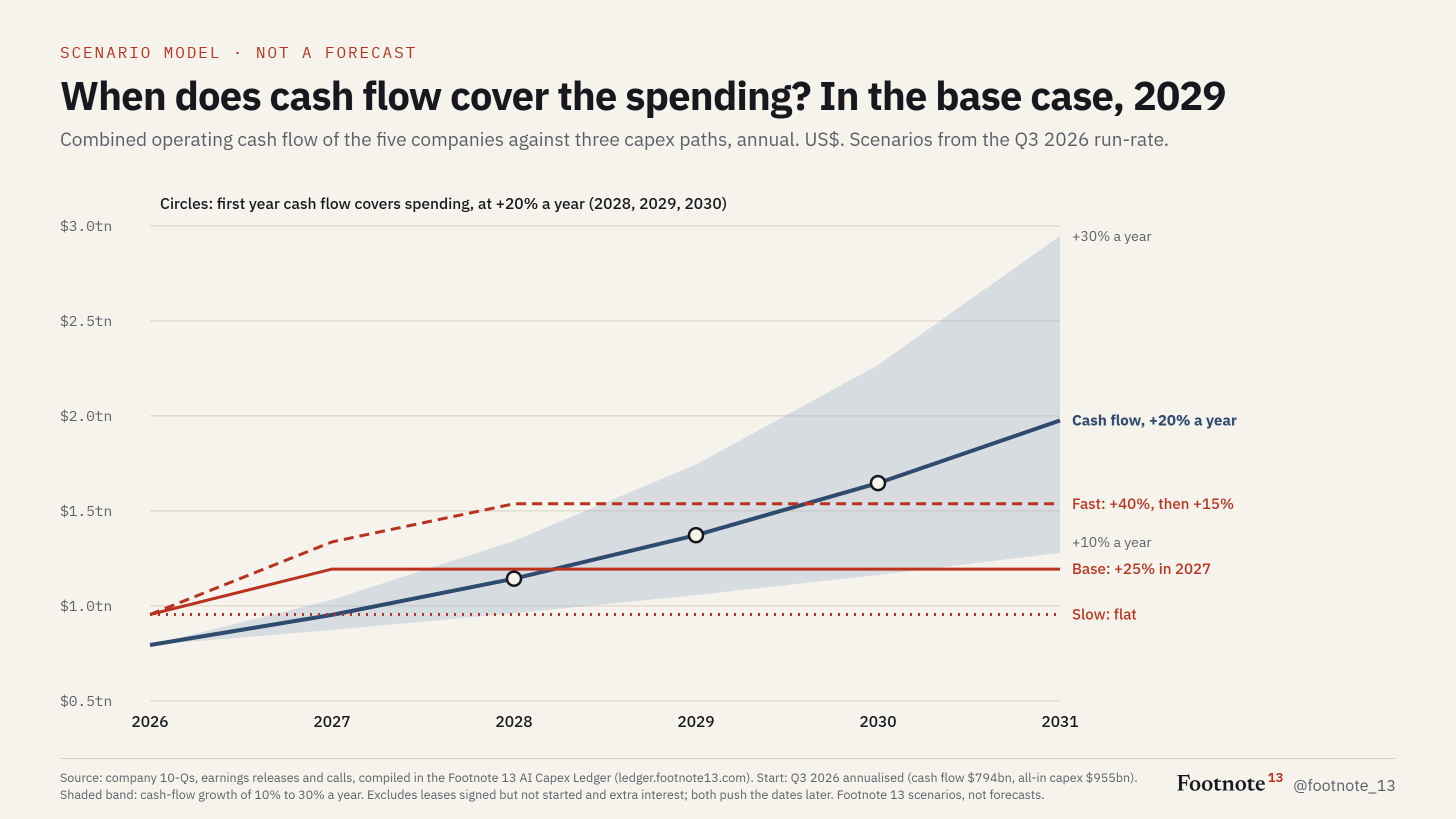
Start: Q3 2026 annualised, $794bn of operating cash flow and $955bn of all-in capex.
Base case: cash flow +20% a year, capex +25% in 2027 and then flat. Cash flow covers capex in 2029.
Cumulative shortfall in the base case: about $290bn by the end of 2028.
10% a year: Slow capex (flat) 2028; Base (+25% in 2027) 2031; Fast (+40%, then +15%) after 2031
20% a year: Slow capex (flat) 2028; Base (+25% in 2027) 2029; Fast (+40%, then +15%) 2030
30% a year: Slow capex (flat) 2027; Base (+25% in 2027) 2028; Fast (+40%, then +15%) 2029
The table shows the first year in which combined cash flow covers capex. Cash flow grew 30% in the past 12 months.
The base case is optimistic. It assumes that cash flow grows 20% a year for five years and that capex stops rising after 2027. Only Oracle has said that its capex will peak. A slightly less favourable path moves the date by years:
Change to the base case → Break-even year:
Base case: 2029
Capex also rises 10% in 2028; cash flow grows 15%: 2030
Capex rises 10% a year to 2030; cash flow grows 20%: 2030
Capex rises 10% a year to 2030; cash flow grows 15%: 2031
Cash flow grows 10%; capex as in the base case: 2031
The model adds the five companies together, so Microsoft's surplus offsets Amazon's deficit. It excludes extra interest on new debt. The test is a low one: it marks the year the companies stop needing outside money, not the year the investment earns its cost of capital.
6. The lease model: what $1.3 trillion adds
The five companies have signed $1.3 trillion of leases that have not started. A lease enters the accounts when the landlord hands over the building. Until then it appears only in a note.
Key numbers
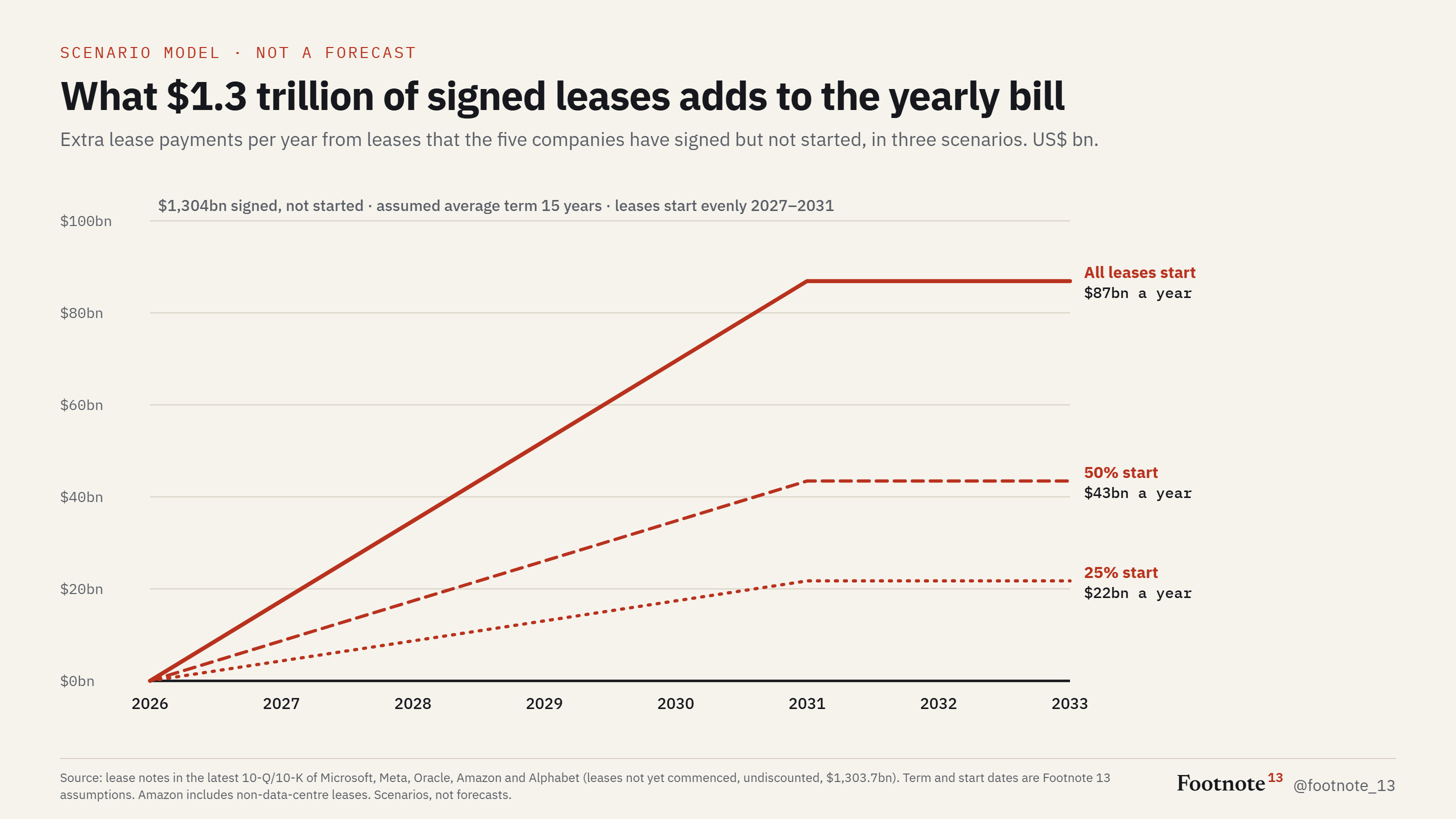
Signed, not started: $1,303bn (Microsoft $365bn, Meta $356bn, Oracle $288bn, Amazon $165bn, Alphabet $131bn).
If all of it starts: about $87bn of lease payments a year from 2031.
If half starts: $43bn a year. If a quarter starts: $22bn a year.
100%: Lease payments a year from 2031 $87bn; As % of today's $955bn capex rate 9%
50%: Lease payments a year from 2031 $43bn; As % of today's $955bn capex rate 5%
25%: Lease payments a year from 2031 $22bn; As % of today's $955bn capex rate 2%
Assumptions: an average term of 15 years and starts spread evenly over 2027 to 2031. The companies do not all use 15 years, and three of them give no term. Oracle discloses 15 to 19 years. Meta discloses terms of up to 30 years, and its July leases run 18 to 20. Microsoft, Alphabet and Amazon give no term for leases that have not started. The term changes the result: with a 10-year average the 100% case is $130 billion a year, and with 20 years it is $65 billion. Amazon's figure includes warehouses and other non-data-centre leases.
The lease line is not added to capex. A finance lease enters all-in capex once, at the start, and its later payments would count the same lease twice. An operating lease never enters capex; its payments reduce operating cash flow. The filings do not split the $1.3 trillion between the two types. Microsoft's new lease assets in the third quarter were $6.5 billion operating and $5.2 billion finance, against $1.4 billion and $9.1 billion a year earlier.
Even if every lease is an operating lease and all of them start, the base case in part 5 still breaks even in 2029, and so do the other cases with cash flow growing 20% or 30% a year. The slower cases move about a year later: cash flow growing 10% a year, and capex rising 10% a year to 2030. The $1.3 trillion is spread over 15 years or more, so its yearly weight is small next to capex. The larger effect is on the balance sheet: the leases are fixed obligations that do not appear as debt.
Three measures to watch
Backlog becomes revenue on schedule. Microsoft expects to recognise about 30% of its $677 billion within 12 months. If that amount grows in dollars each quarter, the contracts are converting.
Capex stops rising while cash flow keeps growing. In the past 12 months combined cash flow grew 30% and all-in capex grew 82%.
Spreads stop widening. Oracle's next dollar deal against 310 basis points, and Meta's against 160, will show whether lenders see more risk or less.
The next post, on Tuesday 1 December, opens the ledger's capex-guidance tracker: what each company said it would spend, and how often it raised the figure.
Sources: company 10-Qs, earnings releases and calls (Q1 2024 to Q3 2026), compiled in the Footnote 13 AI Capex Ledger; pricing term sheets (Form FWP) for 17 bond deals filed with the SEC in 2026; Anthropic S-1/A, 10 November 2026; OpenAI announcements; Oracle Investor Day, 28 October 2026; Nvidia results and call, 17 November 2026; CoreWeave Q3 2026 results; US 10-year Treasury yield (Federal Reserve H.15 via Alpha Vantage, pulled 21 November 2026); ICE Data Services; S&P Global Market Intelligence; Bradstreet's, 30 December 1893; S. Daggett, Railroad Reorganization (1908); Federal Reserve History. Bonds sold without an SEC term sheet (Swiss francs, Australian dollars) are not in the bond data. Lab shares of backlog, G-spread averages and all scenarios are Footnote 13 calculations. Not investment advice.
How to cite: Footnote 13, "When does it pay back?", 27 November 2026, using the AI Capex Ledger (ledger.footnote13.com), CC BY 4.0.
Disclosure: this post uses the Footnote 13 Commitments Map, which tracks contracts involving Anthropic. Footnote 13 is produced with Claude, made by Anthropic. The same rules apply to every lab.
How I make this: I choose the questions and the argument. AI tools (mainly Claude, made by Anthropic) pull figures from official data and filings, build the charts and draft text, which I edit. Every number is checked against its source.